

Teen Umpires: The Recruiting Unlock Most Leagues Fumble
Teens are the most available officiating labor in America. How to recruit teen umpires, protect them, pay them legally, and grow one into your best plate ump.
By Erik Short ·
Quick answers
Where do I find teen umpires? Through high school PE teachers, athletic directors, and varsity baseball/softball coaches — the kids who love the game but got cut are your best pool.
How young can an umpire be? Most rec leagues start kids at 14–15 on the bases in younger divisions, with an adult partner; save the plate for 16+.
Do I have to pay teenagers to umpire? Usually yes, and child-labor rules on hours and school nights apply — treat game fees as real wages, not a favor.
What ruins a teen umpire fastest? A screaming parent in their first three games with no adult standing beside them to shut it down.
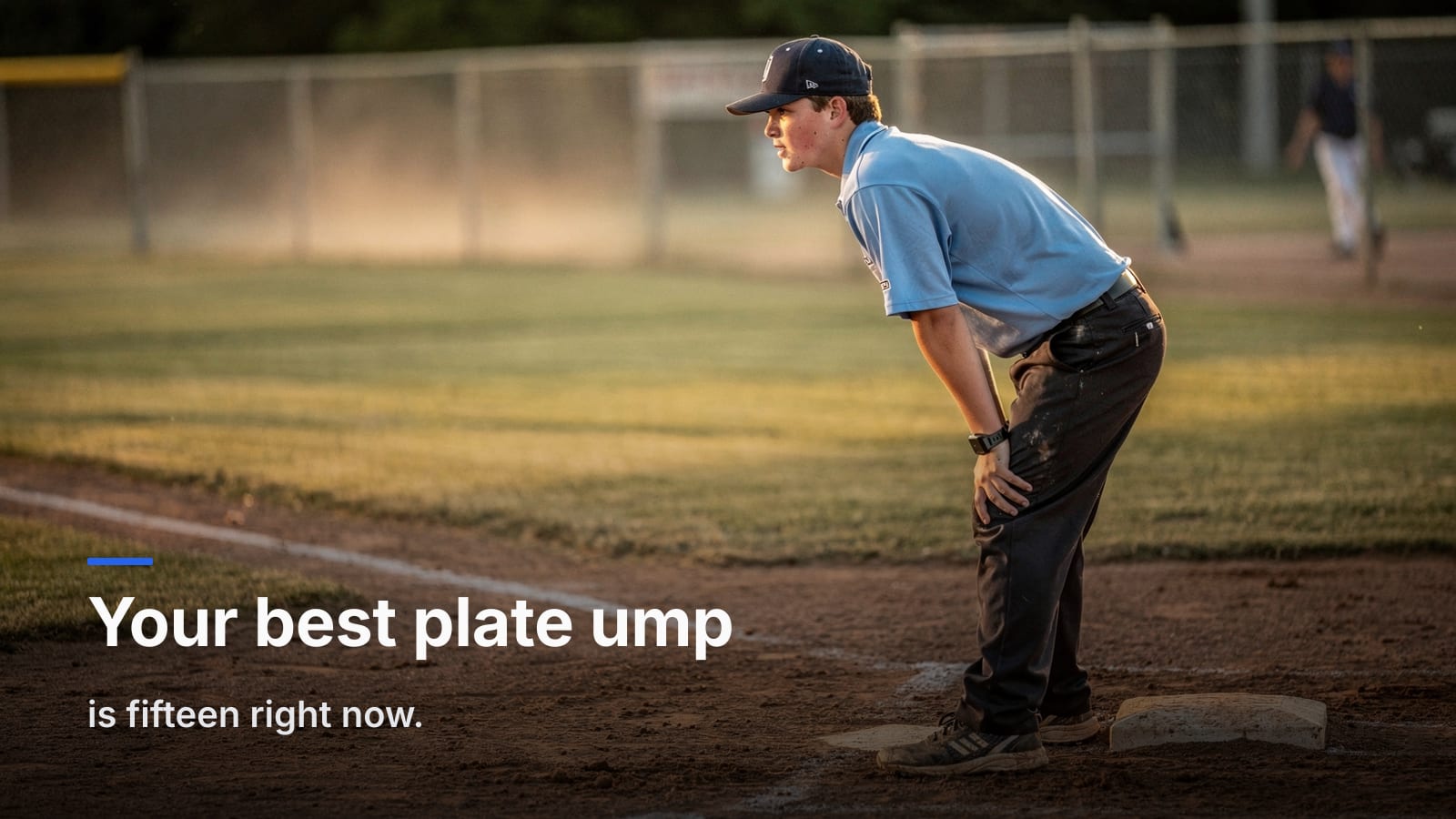
How long until a teen is good? A 15-year-old who works steadily and gets real mentoring is often your best plate umpire by 18.
The most available labor in America is standing in your dugout
Every commissioner I know complains they can’t find umpires. And every one of those same leagues is full of 15-year-olds — kids who played until they got cut, kids who still show up to watch their little brother, kids who need a summer job that isn’t folding shirts at the mall.
Teenagers are the most available officiating labor in the country. They’re local, they’re cheap by the standards of a rec budget, they already know the game, and they have exactly the flexible summer-evening availability your schedule needs. The catch is that most leagues take a willing 15-year-old, throw him behind the plate for a coach-pitch tantrum on night one, and never see him again.
That’s not a kid problem. That’s a program problem. Recruiting teenage umpires is the easy part. Keeping them past their first bad night is where leagues fumble — and I’ve fumbled it myself. Here’s how to build a youth umpire program that actually turns raw teenagers into the backbone of your crew.
Recruit where the teenagers already are
You don’t recruit teens the way you recruit adults. Adults find you through the sign-up form. Teenagers have to be tapped on the shoulder by someone they trust.
Go straight to the schools:
- The varsity baseball and softball coaches. Every spring they cut kids who love the game and are heartbroken about it. Those kids know the rules cold and have nowhere to put that energy. Ask the coach for three names.
- The athletic director. Some schools run community-service or work-study hours; a paid officiating gig can qualify.
- PE teachers and the guidance office. They know which kids need a job and are responsible enough to hold one.
- Your own alumni. The 12-year-olds who aged out of your league two years ago are now 14. Email their parents. They already love your league.
When you pitch it, pitch it to the parent and the kid at the same time. Parents want to hear it’s a real job with real pay, a schedule they can see in advance, and an adult standing next to their kid. Kids want to hear it pays better than the mall and they get to boss coaches around. Both things are true.
If you want the broader playbook for filling a roster, I laid out the whole thing in how to recruit umpires for your league. Teens are one channel; treat them as their own channel with their own pitch.
Never send a teenager out alone
This is the rule that saves the whole program, so I’ll say it plainly: a teenager’s first games always have an adult on the field with them.
Not an adult in the parking lot. Not an adult “you can call if there’s a problem.” An adult standing on the other base or behind the plate, in uniform, working the game beside them. Pair every new teen with a steady veteran for their first stretch — I’d say at least their first five or six games, longer if you can swing it.
The partner does three jobs:
- Handles the situations a 15-year-old shouldn’t have to. An ejection, a coach who won’t back off, a rule nobody’s sure of — the adult takes it.
- Teaches in real time. “Get to the plate side quicker on that.” “Good hustle, sell that call harder.” You can’t teach positioning from a classroom; you teach it between innings.
- Is a wall between the kid and the crowd. More on that next, because it’s the big one.
The two-umpire system is the natural home for this — the veteran takes the plate, the teen learns the bases where the mechanics are simpler and the pressure is lower. That’s also exactly the arrangement that grows a teen into a plate umpire, because they watch a good one work the plate for a whole season before they ever put the mask on.
Enforce spectator behavior twice as hard for kids
Here’s the ugly truth every league has to face: a grown man who would never scream at another grown man will absolutely scream at a 15-year-old. Something about a teenager in blue makes the worst parents feel entitled to unload.
You cannot let that happen, because it will end your youth program in one season. One kid goes home crying because a dad called him a cheat over a bang-bang play at first, and that kid never comes back — and neither do the three friends he was going to recruit.
So the standard for behavior toward a young official is stricter than for anyone else, and you say so out loud:
- Announce it. At the coaches’ meeting: “We have young officials this year. Anyone who directs abuse at a teenage umpire is done for the day, first warning is a courtesy, and I may not give it.”
- Empower the adult partner to eject on the teen’s behalf. The kid doesn’t have to fight that battle. The veteran does.
- Back the call every time, later. Even when the teen blew it. You correct mechanics in private; you never let a coach litigate it through a child in public.
I wrote a whole piece on protecting umpires from abusive parents and coaches — with teenagers, dial every one of those protections up. It’s not coddling. It’s the difference between a program that lasts and one that doesn’t.
The labor-law basics you can’t wing
If you’re paying teenagers — and you should be — you’re now a small employer of minors, and there are rules. I’m a commissioner, not a lawyer, so check your own state, but here’s the shape of it:
- Pay is real money, not a favor. Game fees to a minor are wages. That means keeping records of who worked, when, and for how much. Your end-of-season wrap-up numbers matter more, not less, when minors are on the roster.
- Age floors exist. Federal rules generally allow 14- and 15-year-olds to work non-hazardous jobs (officiating qualifies), with restrictions. Under 14 gets complicated fast — most leagues just don’t.
- Hours are limited on school days and school nights. During the school year, 14–15 year-olds face daily and weekly hour caps and can’t work late on a night before school. Your spring fall-ball schedule has to respect that; summer is looser.
- Some states require work permits for minors, issued through the school. Ask the athletic director — they usually know the process cold.
- Nail down whether they’re employees or contractors, because most youth-league umpires are treated as independent contractors and the paperwork differs. Talk to whoever does your league’s books.
None of this is scary once. It’s scary if you ignore it for three years and then a parent asks a pointed question. Set it up right at the start.
The development path: 15 to 18
The reason to put in all this work is what happens at the end of it. A teenager who is recruited well, protected hard, and taught steadily becomes something you can’t buy: a homegrown, reliable, genuinely good umpire who’s loyal to your league because you’re the one who built him.
Here’s the arc I aim for:
Age 15 — bases, younger divisions, always paired. Coach-pitch and the youngest kid-pitch divisions. Bases only. Adult partner every game. Goal: get comfortable making a call out loud in front of people and not melting.
Age 16 — bases in older divisions, first plate reps in the little kids’ games. Now the game is faster and the teen can handle it. Start giving them the plate in low-pressure games with the veteran on the bases spotting them. Fold them into the regular rotation.
Age 17 — plate umpire in most divisions, mentoring the new 15-year-olds. They’ve seen enough. Now they can carry a plate assignment solo in all but your toughest games — and, crucially, they become the adult-in-training for the next kid you recruit.
Age 18 — one of your best. A four-year-trained plate umpire who grew up in your league is better than most adults you’ll ever hire off the street, and they know it. Pay them like it.
Getting from 15 to 18 requires you to actually track development, not just fill slots. Light-touch evaluations help — I keep it un-weird using the approach in running umpire evaluations without making it weird. And fair game counts matter double for teens: a kid who gets three games all summer never develops, and a kid who gets buried in twelve while burning out on schoolwork quits. A fairness view of who’s worked what keeps the reps flowing evenly.
Where the software actually earns its keep with teens
I don’t drag UmpCrew into every post, but this is a place where the right tooling genuinely matters, so I’ll say it once.
Teenagers live on their phones and ignore email entirely. If you assign a 15-year-old a Saturday game by email, he will not see it. When an assignment goes out as an instant text and push notification with the date, field, and a one-tap calendar link, he sees it — and so does the parent driving him. The automatic reminder before the game is doing quiet parenting on your behalf. If you’re wrestling with why the group text keeps failing your youngest umps, text vs. email vs. push gets into it.
The same fairness dashboard that keeps veterans happy is what lets you spread reps evenly across a growing bench of teens and see at a glance who’s ready for more.
Frequently asked questions
Should teenage umpires work games with kids they know?
Avoid it early on. Working a division with their younger siblings’ friends or their own former teammates puts them in an impossible spot with parents. Assign teens to divisions where they don’t have social ties until they’ve got some confidence.
What should I pay a teenage umpire?
Pay them a real, fair game fee for the level they’re working — generally the same rate an adult gets for that same game, adjusted for whether they’re on the bases or the plate. Underpaying teens because they’re young is both a legal gray area and a fast way to lose them. See our breakdown in how much to pay umpires.
How do I handle a parent complaint about a teen umpire’s call?
You handle it, not the kid. Take the conversation privately, back the call in the moment, and coach the mechanics later in private. Never let a coach or parent cross-examine a minor about a judgment call on the field.
Can teenagers umpire adult or high-level travel games?
Generally no. Keep teens in youth divisions at or below their own age range. Adult rec and competitive travel ball bring abuse and speed that even good teens shouldn’t have to absorb yet.
How many teen umpires can one veteran mentor at a time?
Realistically one per game, and no more than two or three teens actively in the pipeline per veteran across a season. Mentoring is real work; spread it across your steadiest adults so nobody burns out on it.
If you’d rather not build the whole roster and notification system by hand, start a free 14-day trial — or email hello@umpcrew.com and we’ll set your league up for you.