

Youth Umpire Scheduling: Little League, Ripken, Babe Ruth
Scheduling youth baseball umpires: mixing volunteer parents with paid teens, per-division crew sizes, sanctioning registration, and handling conflicts.
By Erik Short ·
Quick answers
- How many umpires does a youth game need? Coach-pitch and tee-ball usually run one; Minors/Majors typically want two; upper divisions and playoffs often go three.
- Can parents umpire in youth leagues? Yes — many rec divisions run on volunteer parent umps, often alongside paid teenagers, but you need to schedule around their own kids’ games.
- Do youth umpires have to register with the sanctioning body? Little League, Cal Ripken/Babe Ruth, and USSSA each have their own registration and background-check rules — check the current requirements for your affiliation before your season.
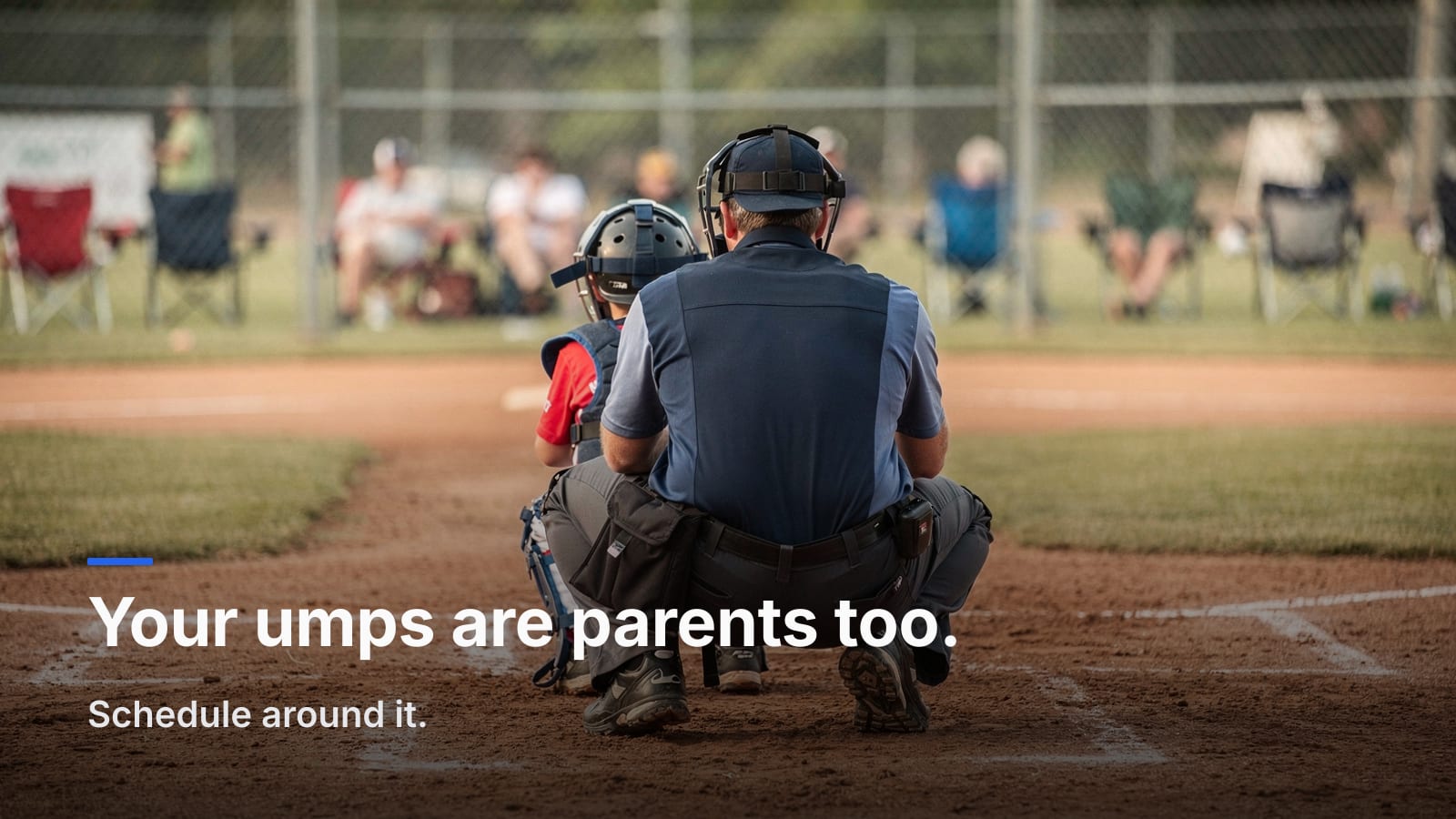
- What’s the biggest scheduling headache? Conflict of interest — your umps are also parents, so you can’t put them behind the plate for their own kid’s team or a division rival.
Youth ball is its own scheduling animal
If you’ve only ever scheduled adult rec or high school, youth league will surprise you. Not because the games are harder to call — they’re usually easier — but because your umpire pool is a moving mix of people with very different reasons for being there.
You’ve got the retired guy who does it because he loves it. You’ve got two or three paid teenagers who just aged out of the majors and want beer money (well, gas money). And you’ve got a rotating cast of parents who signed up “to help out” and would quietly love an excuse to skip a Saturday. Scheduling all of them together — across five or six divisions, each with its own crew-size norm — is the actual job.
This is a guide to doing it without losing your Saturday mornings to a group text.
The volunteer-parent-plus-paid-teen model
Most youth leagues I’ve seen run some version of a hybrid umpire program: volunteer parents cover the lower divisions and fill gaps, while a handful of paid teenagers and adults carry the divisions where the games actually count.
That mix is a feature, not a bug. But it changes how you schedule.
- Volunteers need low friction. A parent who agreed to ump three games all season will bail if signing up feels like a job. Make it one tap.
- Paid umps need fairness and predictability. Your teenagers are working for money, and they’ll notice fast if one kid gets eight games and another gets two. Uneven pay from uneven games is how you lose your best teen umps to the rec-soccer refs down the road. We wrote a whole piece on rotating crews fairly — it matters double when some umps are paid and some aren’t.
- Everyone needs the same information. Date, time, field, teams, plate or bases. It doesn’t matter whether they’re getting a check or a thank-you; a missed detail is a no-show either way.
The trap is treating volunteers and paid umps as two separate systems — a sign-up sheet for the parents and a text thread for the teens. Two systems means two things to forget. Keep everybody in one place.
Crew size by division
Youth crew sizes track the level of play, and the sanctioning bodies publish guidance, but here’s the working reality most rec leagues land on:
| Division | Typical crew | Why |
|---|---|---|
| Tee-ball / coach-pitch | Solo (often a volunteer) | Nobody’s stealing; you need a rule-keeper, not mechanics |
| Minors (kid-pitch, ~9–10) | One or two | Steals and force plays start to matter |
| Majors (~11–12) | Two | Real base running, real bang-bang plays |
| Intermediate / Juniors (50/70, big diamond) | Two, sometimes three | Bigger field, more ground to cover |
| Playoffs / All-Stars | Two or three | The games people remember — staff them up |
If you’re not sure where a specific division should land, we broke down the whole question in 1, 2, or 3 umpires? and got into the footwork in the 2-umpire system.
A scheduling note that trips people up: in a two- or three-person crew, only the plate job is really unique per game — the base and field positions can repeat across your crew. Whatever tool or spreadsheet you use, make sure it lets you assign the plate separately from the bases, because that’s the slot that most needs your best available ump.
Sanctioning-body registration comes first
Before you schedule a single game, know your affiliation’s umpire rules — they’re not optional and they change.
- Little League has its own umpire program, training resources, and — critically — volunteer application and background-check requirements for anyone in an on-field volunteer role. A parent ump is usually a league volunteer, which means the same paperwork as a coach.
- Cal Ripken / Babe Ruth (Babe Ruth League) publishes umpire guidance and clinics through its structure, with its own registration expectations.
- USSSA and other travel/tournament bodies register umpires separately, often per-event.
I’m not going to quote current fees or exact steps here, because those genuinely do change year to year — go to your affiliation’s site and read this season’s requirements. The point is: a scheduled ump who isn’t a registered, background-checked volunteer is a liability, not a solution. Build your registration deadline into your calendar before you start assigning games, so you’re never in the position of pulling a warm body out of the stands to cover a field.
The conflict-of-interest problem nobody warns you about
Here’s the thing that makes youth scheduling different from every other level: your umpires are parents, and their kids are on teams in your league.
You cannot put a dad behind the plate for his own son’s game. You probably shouldn’t put him on a direct division rival either — even if he’d be perfectly fair, the losing team’s parents won’t see it that way, and protecting your umps from that fight is part of the job. (If you haven’t thought about the parent-in-the-stands dynamic, protecting umpires from abusive parents and coaches is worth a read.)
So your scheduling has an extra filter most leagues don’t:
- Know which team each volunteer ump’s kid plays for. Collect it once, at registration.
- Never assign an ump to their own child’s game. Non-negotiable.
- Be cautious with direct rivals in the same division. Optics matter as much as fairness here.
- Watch the calendar collision. A parent ump can’t work the 10:00 on Field 2 if their kid’s team plays the 10:00 on Field 4. They’re going to watch their kid. Every time. And they should.
That last one is really an availability problem, and it’s why collecting blackout dates up front is non-negotiable in youth ball — a parent ump’s “unavailable” list is basically their kid’s game schedule. We got into how to gather that cleanly in collecting umpire availability without the chaos.
The Saturday-morning reality
A youth league doesn’t spread games out like an adult league does. You cram fifteen games onto four fields on one Saturday, run them back to back, and pray nobody rains out. That’s a scheduling pattern that punishes anything manual.
Two things save you:
- Import the whole slate at once. If your league runs its schedule in a spreadsheet or a registration platform, don’t retype it game by game. Pull it in as a CSV and assign from there. (CSV import is exactly this — one upload, whole season on the board.)
- Let people confirm without you chasing them. When you assign an ump, they should get an instant text with the details and a reminder before the game — and if a parent can’t make it, they should be able to drop it and let another ump claim it without going through you at 9:40 on Saturday. That self-serve piece is the difference between a calm morning and a phone that won’t stop buzzing.
That’s honestly where a scheduling tool earns its keep for youth leagues. UmpCrew was built for exactly this size of operation — a volunteer commissioner running baseball and softball on nights and weekends. You import the schedule, assign crews (or let the fairness dashboard auto-suggest the ump with the fewest games so your paid teens stay even), and everybody gets an instant SMS the moment they’re on. Umps use the app free; you flag the parent conflicts once and stop re-solving them every week.
Frequently asked questions
Should volunteer parent umps be paid?
Usually not — that’s the deal, they’re volunteers. But be crystal clear about which roles are paid and which aren’t, and keep game counts even among your paid umps. Mixing paid and unpaid in the same crew is fine as long as nobody’s confused about which one they are.
How young can a paid youth umpire be?
Many leagues start teens at 13–14 umping the lower divisions, then move them up as they gain reps. Check your sanctioning body’s minimum age and any junior-umpire program — Little League and others have structured tracks for exactly this.
What if a parent ump’s kid gets moved to a different team mid-season?
Update your conflict list the moment it happens. Draft trades, call-ups, and division moves all change who a given ump can and can’t work. This is one more reason to keep conflicts in your scheduling tool rather than in your head.
Do we need certified umpires for regular-season youth games?
For rec regular-season play, most leagues train their own volunteers and teens — see how to train new umpires. Tournament and All-Star play often requires registered or certified umpires, so check the specific event’s rules well ahead of time.
How do we cover a Saturday when three umps cancel?
Build a sub pipeline before you need it — a short list of umps who’ll take open games, plus a self-claim system so an open slot can get grabbed without you making ten calls. We walk through it in building a sub pipeline that saves the game.
If retyping the season and dodging parent conflicts by hand is eating your Saturdays, start a free 14-day trial — or email us at hello@umpcrew.com and we’ll set your league up for you.