

One-Umpire Mechanics: Working a Game Solo
A practical one-man umpire system for rec and youth ball: where to stand, which calls you'll miss, and how to set expectations with coaches before first pitch.
By Erik Short ·
Quick answers
Where does a solo umpire stand with nobody on base? Behind the plate for pitches; on a batted ball, come out and get an angle on the lead play — usually first base.
Where do you stand with runners on? Many one-man umpires move behind the pitcher (the “slot” behind the mound) so they can cover the bases and still see the plate from the front.
What calls will you miss working alone? Trap catches in the outfield, swipe tags, pulled feet at a far base, and some pitches when you’ve slid out to cover a play. You won’t get them all, and that’s fine — set expectations early.
Should I start behind the plate or behind the pitcher? Behind the plate gives you the best strike zone and the most protection; behind the pitcher gives you better base coverage. Pick based on the level and your gear.
Most mechanics guides are written for crews. Two umpires, three umpires, rotations, who takes the touch at third — all of it assumes you’ve got help standing 90 feet away. That’s great if you’ve got the bodies.
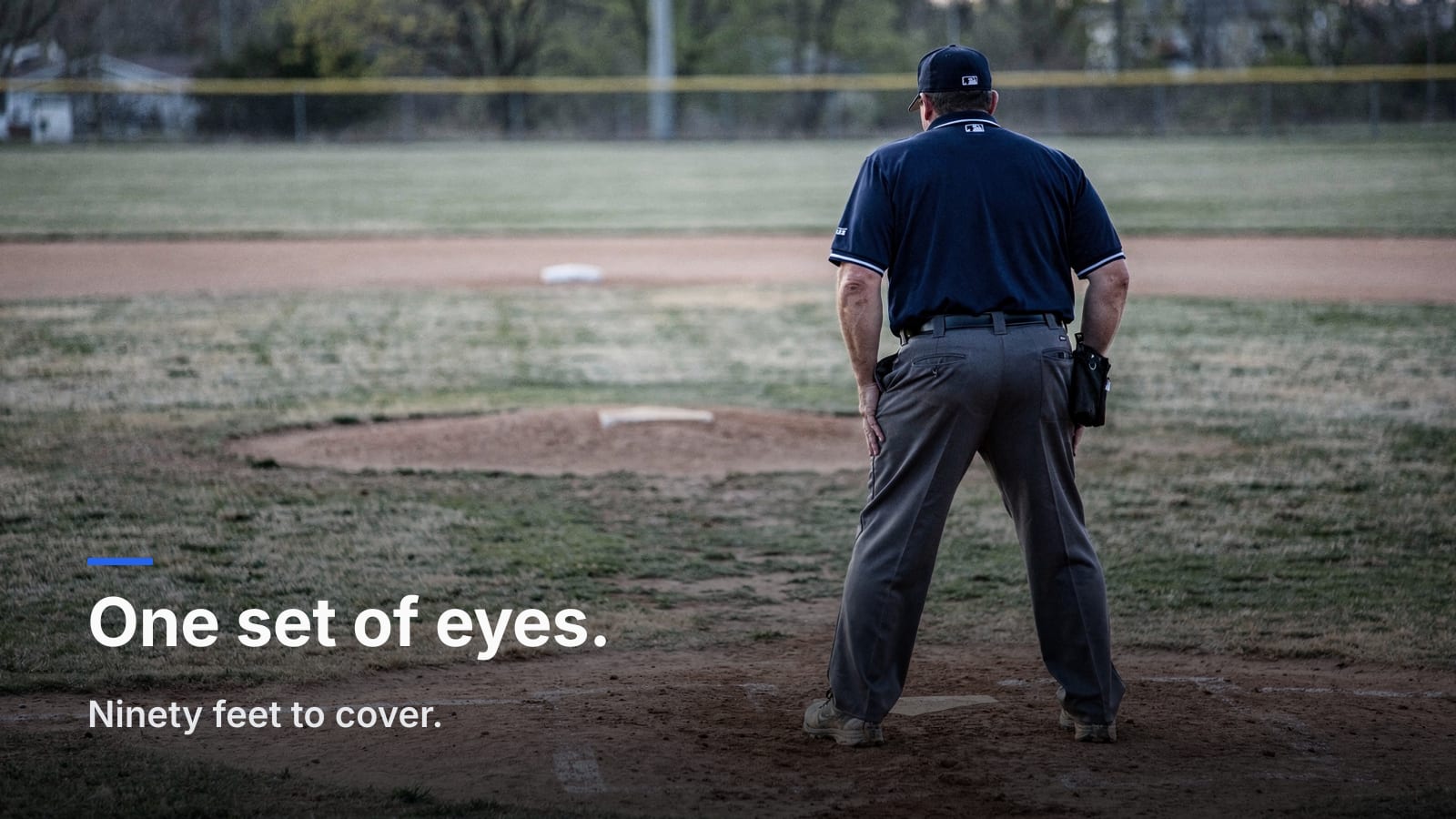
But if you run a rec or youth league, you already know the truth: most games get one umpire. One person, behind the plate or behind the mound, covering 90 feet of basepaths and a strike zone at the same time. The “one man umpire system” isn’t a fallback. For a lot of us, it’s the whole job.
So let’s talk about how to actually do it well — where to stand, which calls you’re going to miss, and how to tell the coaches that before anybody’s yelling.
First: tell the coaches you’re alone
This is the single most useful thing you can do, and it takes thirty seconds at the plate meeting.
“Guys, it’s just me tonight. I’ll bust it to get every angle I can, but I’m one set of eyes covering the whole field. I’ll give you my best look on every play. Let’s have a good game.”
That’s it. You’ve just done three things:
- Set the expectation that some calls are going to be tough angles.
- Signaled that you’re hustling, not loafing.
- Given yourself cover when you inevitably get caught on the wrong side of a bang-bang play at third.
Coaches aren’t unreasonable when you’re honest with them up front. They get unreasonable when they feel like you’re hiding something or dogging it. Name the constraint out loud and most of the heat goes away before it starts. (If it doesn’t, we wrote a whole piece on protecting umpires from abusive coaches and parents — worth a read before the season.)
Two starting positions, two tradeoffs
There are two legitimate places to start a solo game. Neither is wrong. They trade strike-zone quality and safety against base coverage.
Behind the plate
This is the default, and for younger levels it’s usually the right one.
You get: the best possible strike zone, full protection (mask, chest protector, shin guards), and the clearest look at the plate — swings, foul tips, hit-by-pitch, plays at home.
You give up: base coverage. When the ball’s hit, you’re starting from the slowest, heaviest position on the field and you’ve got to come out, clear your gear mentally, and sprint to get an angle. On a ball in the gap with runners moving, you’re going to be late to something.
Start behind the plate when the pitching is live enough that you need protection and a real zone — which, honestly, is most youth and rec baseball and the plate meeting is where you earn the game.
Behind the pitcher
Here you set up in the slot behind the mound, off to one side, so you can see the plate over or past the pitcher and still be a short sprint from any base.
You get: dramatically better base coverage. You’re already in the middle of the diamond. Plays at second, steals, pickoffs, force plays — you can get to all of them.
You give up: your strike zone takes a hit calling from 55-plus feet behind the pitcher, and you usually can’t wear the plate gear comfortably back there, which means less protection on a line drive up the middle. That’s the real safety tradeoff. A screaming comebacker finds the guy behind the mound.
Behind the pitcher makes the most sense in slower-pitch softball, coach-pitch and tee-ball where the pitched-ball zone barely matters, or adult rec where the batted ball is the whole game and everyone’s agreed the zone is generous.
A lot of experienced one-man umpires actually switch during the game: start behind the plate, and once a runner reaches base, move out behind the pitcher for the next hitter so they can cover the bases. More on that in a second.
Positioning, situation by situation
Here’s the core of solo umpire positioning. The goal every time is the same: get an angle, not distance. Being close doesn’t help if you’re straight-lined. Being 40 feet away at a good angle beats being 15 feet away looking through bodies.
Nobody on
Stay behind the plate. On a batted ball:
- Grounder in the infield: come out toward the first-base line, get into fair territory a bit, and take the play at first from an angle where you can see the foot hit the bag and catch the ball in the glove. Don’t chase down the line in foul ground — you’ll be straight-lined on the pulled foot.
- Base hit to the outfield: come out and read the batter-runner. If it’s a clean single, you’re just watching the touch of first and trailing the runner toward second in case it becomes a play. Hustle a few steps into the infield so you’re not making a 120-foot call from home plate.
- Fly ball / possible trap: this is a hard one solo. Get out from behind the plate, move toward the ball, and get the best look you can at the catch-or-trap. You will not always get it. (See below.)
Runners on
This is where behind-the-pitcher earns its keep. If you’ve moved out:
- Steal or play at second: you’re right there. Move to get a 90-degree angle on the tag — not straight in line with the throw.
- Ground ball with a force: read the lead play. On a routine 6-4-3 you want the force at second first, then recover toward first if there’s a play. You’ll miss the trail end of some double plays. Prioritize the lead runner.
- Ball in the gap, runners moving: pick up the lead runner and the bases. The catch is almost secondary to the baserunning — you can’t be everywhere, so protect the plays that decide the inning.
Fly balls and the outfield
Nobody covers the outfield well alone. Your honest job on a deep fly is to move toward it and commit to either the catch or the plays. If there’s a runner tagging, you often have to let the catch go to your best judgment and turn to get the play at the base. Pick the call that matters more to the game and get that one right.
The calls you will miss — and that’s okay
Say it plainly because it’s true. Working solo, these are the plays you’ll regularly be straight-lined or late on:
- Trap catches in the outfield, especially the opposite field from where you’ve come out.
- Swipe tags and pulled feet at the base farthest from you.
- Half-swings when you’ve already slid out to cover a runner and your back is half-turned.
- The trail end of a double play while you’re watching the force.
- A runner touching a base on a multi-base play where you had to pick the lead play.
You manage this three ways: hustle to improve every angle you can, call what you actually saw (never guess at the play you didn’t see), and lean on the expectations you set at the plate. “I had the force at second; I didn’t have a clean look at the touch at third” is an honest, respectable answer. Guessing and getting caught is what blows up a game.
If you want the contrast, our 2-umpire system breakdown shows exactly which of these plays a second umpire picks up — and our guide on how many umpires per game helps you decide when a game really does need two.
The scheduling side: don’t make the same ump fly solo every week
Here’s the part that’s on the commissioner, not the umpire. Working alone is harder, more tiring, and more exposed to angry coaches. If your schedule quietly assigns the same reliable person to every solo game while the crewed games get spread around, that person burns out. We’ve watched it happen — it’s a big piece of why umpires quit.
Two fixes:
- Track who’s working alone, not just how many games each ump has. A solo plate game is worth more than a base spot on a crew in terms of wear.
- Rotate the solo duty the same way you’d rotate the plate.
This is exactly the kind of thing a fairness dashboard is for — it ranks your umps by games worked so the hard, lonely assignments don’t always land on your most dependable person. If you’re still balancing all of this in a spreadsheet, we wrote up the whole migration path to real scheduling software when the group text stops cutting it.
Frequently asked questions
Can one umpire call a whole youth baseball game?
Yes — it’s the norm at most rec and youth levels. You won’t get every angle a crew would, but with honest expectations at the plate and good hustle, one umpire runs a clean, fair game.
Is it safe to umpire behind the pitcher without plate gear?
It’s riskier on comebackers up the middle, which is the main reason it’s better suited to slow-pitch softball, coach-pitch, and tee-ball. If the pitching is live, stay behind the plate in full gear.
How do I handle a close play I didn’t have a good angle on?
Call what you actually saw and own it. “I didn’t have a clean look at that one” is far better than guessing. Setting the “it’s just me tonight” expectation at the plate meeting makes these moments much easier.
Should solo games pay the same as crewed games?
Many leagues pay the solo umpire a bit more than a single base spot on a crew, since they’re doing the plate and the bases alone. Decide it in advance and put it in your umpire handbook.
If you’d rather the solo duty get spread around automatically instead of always landing on your best ump, start a free 14-day trial and let the fairness dashboard do the counting.