

Why Umpires Quit: The Burnout Problem Leagues Can Fix
The umpire shortage is real. Here's an honest breakdown of why umpires quit — and the five causes of official burnout a small league actually controls.
By Erik Short ·
Quick answers
Why are umpires quitting? The top reasons are spectator abuse, chaotic scheduling, last-minute changes, pay friction, and feeling unappreciated — most of which a league controls.
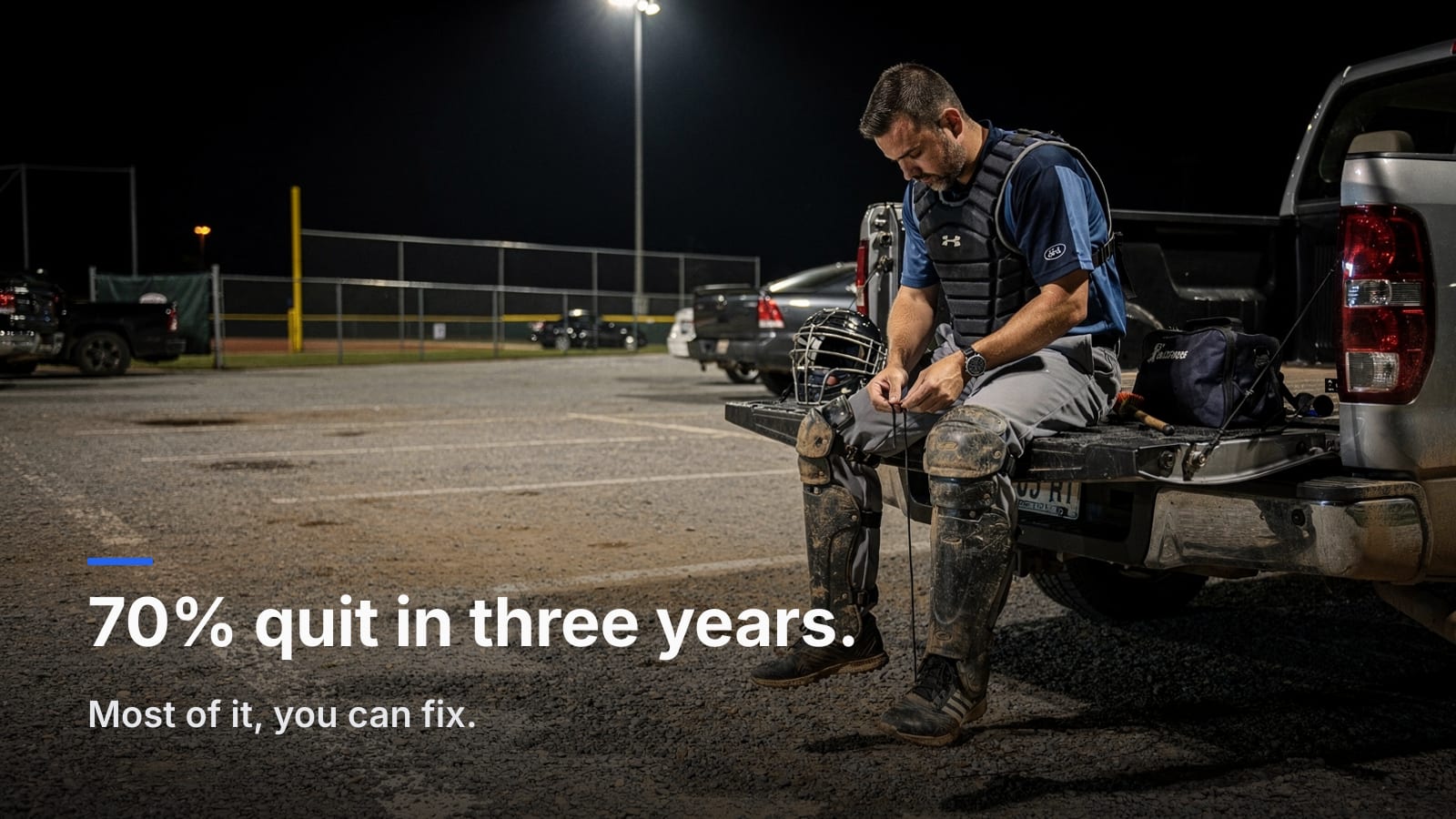
How bad is the umpire shortage? National surveys of officials across sports consistently find that around 70% quit within their first three years, and abuse is cited as the number-one driver.
What can a small league actually fix? Almost everything except the loudest fans — and even there, a visible policy that backs up your ump makes a real difference.
What’s the single biggest retention lever? Treating your umpires’ time with respect: a fair, predictable schedule and no last-minute scrambles.
Every spring I get the same email from a commissioner one league over. “Lost two more umps. Can you spare anybody for Saturday?” I never can. Nobody can. That’s the whole problem.
The officiating shortage isn’t coming — it’s here, and it’s been here for a while. The National Association of Sports Officials has surveyed tens of thousands of officials, and the number that gets quoted most is that roughly 70% of new officials quit within three years. In their survey work, the most common reason officials give for walking away is poor treatment — abuse from parents, coaches, and fans. Baseball and softball aren’t special snowflakes here. We’re right in the middle of it.
Here’s the part that matters for you and me: a lot of what drives umpires out is stuff a league actually controls. Not all of it. But more than you’d think. So let me walk through the causes in roughly the order they bite — and be honest about which ones are yours to fix and which ones aren’t.
The five reasons umpires quit, in order
1. Spectator abuse — mostly yours to fix
This is the one that shows up at the top of every survey, and it’s the one commissioners most want to wave off as “just part of the game.” It isn’t. A new 16-year-old behind the plate getting screamed at over a check-swing by a grown man in a lawn chair is the single fastest way to lose that kid forever. And you will lose him. Teen umps quit over abuse at a brutal rate.
You can’t control that some parents are jerks. You can control whether your league has a spine. The leagues that keep umpires are the ones where:
- There’s a written code of conduct every coach signs, and it names consequences.
- The commissioner — or a designated board member — is reachable and will actually eject a fan.
- Umps know that if they toss a coach, the league backs the ejection instead of second-guessing it on Monday.
The difference between “we have a policy” and “we enforce a policy” is everything. If you’ve never built one, start with the real mechanics — who intervenes, what the escalation looks like, what you say to the parent — in our guide on protecting umpires from abusive parents and coaches. This is the cause you cannot afford to shrug at.
Verdict: You don’t control the jerks. You fully control whether they face consequences.
2. Chaotic, unfair scheduling — entirely yours to fix
This one is quieter than abuse but it grinds people down just as surely. Umpires quit when the schedule feels random and unfair:
- One guy works 22 games, another works 6, and nobody can explain why.
- Assignments land in a group text where half of them get buried.
- The “schedule” is a spreadsheet that’s three versions out of date.
Burnout isn’t only about the loud stuff. It’s the slow resentment of feeling like the schedule is built for the commissioner’s convenience and not the ump’s life. The fix is fairness you can actually show — track games per ump and rotate so the load is even. We get into the specifics in how to rotate umpire crews fairly, and if your real issue is that a group text has quietly become your scheduling system, we wrote about exactly when that breaks down.
A fairness dashboard that shows game counts per ump isn’t just a nice feature — it’s how you answer “why am I working every Tuesday?” with a number instead of a shrug.
Verdict: 100% yours. No excuses on this one.
3. Last-minute everything — mostly yours to fix
Nothing torches goodwill faster than a text at 5:40 for a 6:00 game. Umpires have jobs, kids, dinner. When your league runs on last-minute scrambles, you’re training your most reliable people to stop answering the phone — because answering means getting dumped on.
Some last-minute is unavoidable. Rain happens. A catcher gets stuck at work. But a lot of “last-minute” is actually “I assigned this late and didn’t confirm it.” Build buffer:
- Assign the full season or month up front, not game by game.
- Confirm assignments and send a reminder before game day so no-shows surface early, not at first pitch.
- Have a real sub pipeline instead of a panic text — here’s how to build one.
The no-show that ruins your Saturday usually started as a scheduling gap you could’ve seen coming. If that’s your recurring nightmare, here’s the playbook for handling no-shows and preventing the next one.
Verdict: Weather you don’t control. Your lead time, you do.
4. Pay friction — yours to fix
Here’s the thing about pay: umpires rarely quit over the rate. They quit over the friction. The check that takes six weeks. The “I think we owe you for three games — or was it four?” The cash envelope that never materializes. Getting paid shouldn’t require three follow-up texts and a spreadsheet audit.
Pay people promptly, pay them the right amount, and make the amount predictable. That means knowing your rates, tracking games accurately, and closing the books cleanly at season’s end. If you’ve never pressure-tested your rates, we laid out honest 2026 rates by level, and the end-of-season wrap-up covers paying everyone out without the math turning into a weekend project.
Verdict: Fully yours. Accurate game counts solve most of it.
5. Zero appreciation — yours to fix, and cheap
This is the one that costs nothing and gets ignored most. Umpires absorb abuse, work nights, and get told when they’re wrong and never when they’re right. A little genuine recognition goes a shockingly long way — a text after a well-handled ejection, a thank-you at the end of the season, remembering the guy’s name and that his daughter plays in the 10U.
Retention doesn’t start in October. It starts in July, with a check-in before people are already halfway out the door — more on that here. The leagues that keep umpires year after year aren’t paying the most. They’re the ones where umpires feel like people instead of slots on a grid.
Verdict: Entirely yours, and the cheapest fix on this list.
What you control vs. what you don’t
Let’s be honest instead of pretending you can fix the whole world:
- You don’t control: the national referee culture, whether a given parent is a jerk, the weather, the broader labor shortage.
- You absolutely control: whether abuse has consequences, whether the schedule is fair and predictable, how much last-minute chaos you create, whether people get paid cleanly, and whether anyone ever says thank you.
Count those up. Four and a half of the five biggest reasons umpires quit sit squarely on the league side of the ledger. That’s actually good news. It means the shortage, at your level, is mostly a problem you can do something about — not a weather system you wait out.
Where software actually helps (and where it doesn’t)
I’ll be straight: no app fixes an angry parent or a thin thank-you. But three of the five causes above — scheduling fairness, last-minute scrambles, and pay-tracking friction — are exactly the kind of grind that good tooling takes off your plate.
That’s the whole reason I built UmpCrew. You import your schedule, assign crews (with an auto-suggest that ranks umps by fewest games worked, so fairness is the default), and each ump gets an instant text the moment they’re assigned plus an automatic reminder before the game. Game counts are tracked for you, so pay and fairness both stop being a spreadsheet argument. The commissioner pays; umps use the app free.
It won’t give a 16-year-old a backbone against a heckler. That part’s on you. But it’ll make sure that kid isn’t also quitting because the schedule was a mess and his pay was always late.
Frequently asked questions
Does paying umpires more fix the shortage?
It helps at the margins, but money is rarely the top reason officials quit — treatment and chaos are. A league that pays well but tolerates abuse and runs on last-minute texts will still bleed umpires.
How do I keep teen umpires specifically?
Shield them from abuse aggressively, pair them with a veteran early, and give them predictable games. Teens are the fastest-growing recruiting pool and the fastest to quit over a bad experience — we wrote a full guide on getting it right.
Is the umpire shortage worse in baseball or softball?
It hits both, and the causes are nearly identical. Softball tends to lean on adult rec and youth volunteers, baseball on a slightly deeper assignor network, but burnout and abuse drive people out of both games.
What’s the first thing I should change this season?
Pick the cheapest high-impact fix: a written, enforced conduct policy and a thank-you habit. Then tackle scheduling fairness. You don’t have to fix all five at once.
If the scheduling and pay-tracking half of this is what’s wearing you down, you can start a free 14-day trial — no credit card — or email hello@umpcrew.com and we’ll set your league up for you.